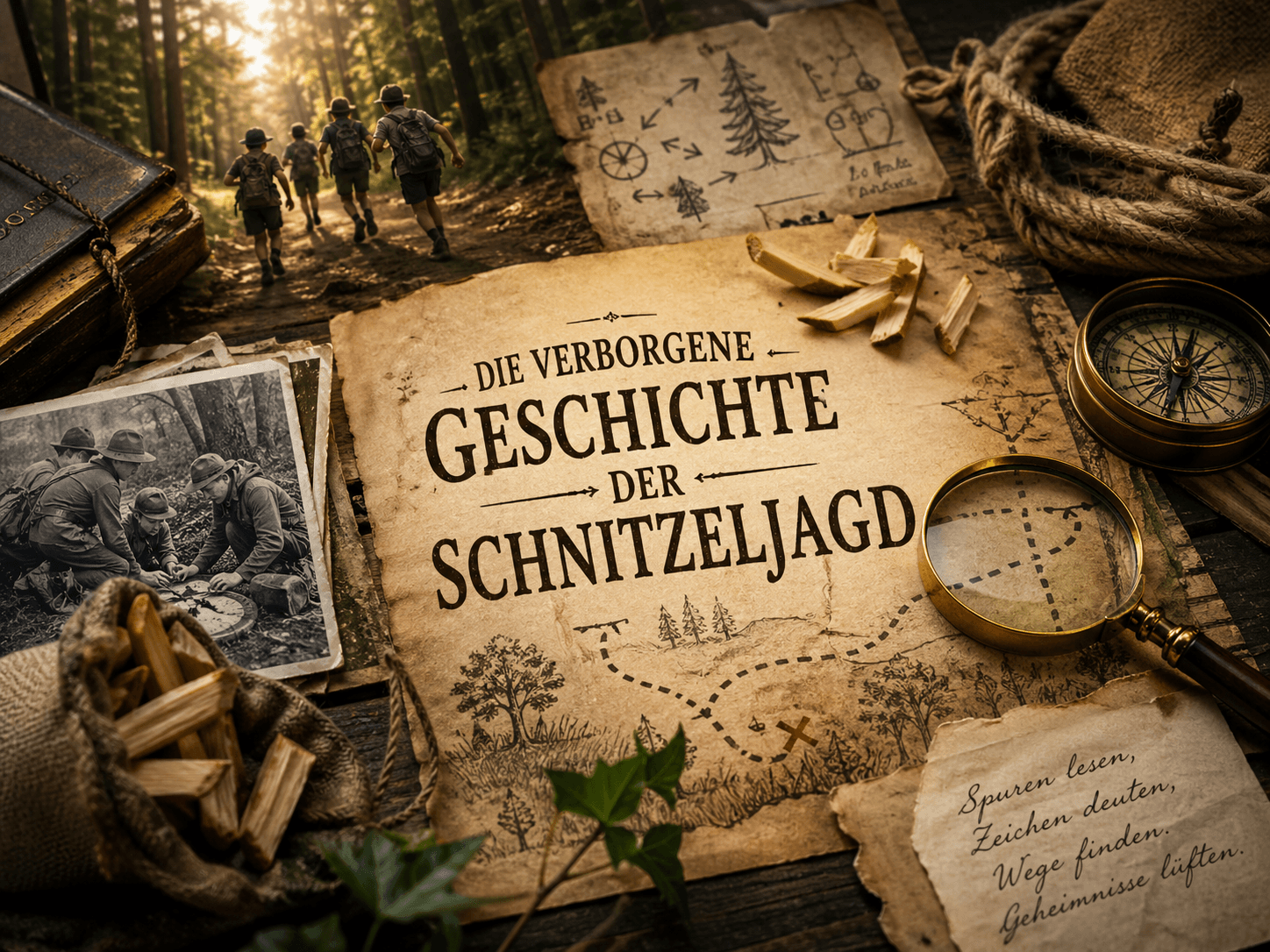
Origins: tracking, not play
The real roots of the scavenger hunt aren’t in games—they’re in tracking. In the 18th and 19th centuries, soldiers, hunters, and scouts used deliberate techniques to follow movement or leave clues without being noticed.
Typical methods included:
- deliberately broken branches
- carefully placed stones
- footprints as an information source
These techniques were later adapted by Robert Baden-Powell in the scouting movement, where the transition from military practice to playful application became more structured.
One often overlooked detail: so-called “crumbs” (wood chips) weren’t just markers—they were coded clues that only insiders could interpret correctly.
The “paper chase” as a precursor to modern hunts
In 19th-century England, the “Paper Chase” (also known as “Hare and Hounds”) became popular. One person laid a trail of paper while others tried to follow it.
What’s rarely mentioned: students often used these games for informal competition and to negotiate social hierarchies. Those who could read trails well were seen as strategically superior—an early mix of sport, tactics, and group dynamics.
- to test endurance and competitiveness
- to demonstrate strategic thinking
- to solidify roles within a group
Early on, the scavenger hunt was already a social system, not just a game.
Scavenger hunts as covert communication
A lesser-known, but historically plausible use:
During wartime and in resistance movements, similar principles were used to transmit messages without written notes.
Examples (not standardized documentation, but derived from military methods):
- stones or branches in a specific arrangement = meeting point
- seemingly random traces = directions
- deliberately “false” trails = deception
The principle matches modern “dead drop” communication—just analog.
The psychological hook: why hunts feel so compelling
Scavenger hunts activate multiple mechanisms at once:
- curiosity + reward (dopamine through progress)
- orientation instinct (like navigating unfamiliar terrain)
- social cooperation (roles, coordination, group dynamics)
That’s why they still work today—even digitally (escape rooms, ARGs).
The key shift most people miss
The biggest change isn’t digital—it’s conceptual:
Before: → focus on following a trail
Today: → focus on experiencing a story
That means:
- puzzles matter more than trails
- narrative replaces pure orientation
- emotion replaces pure technique