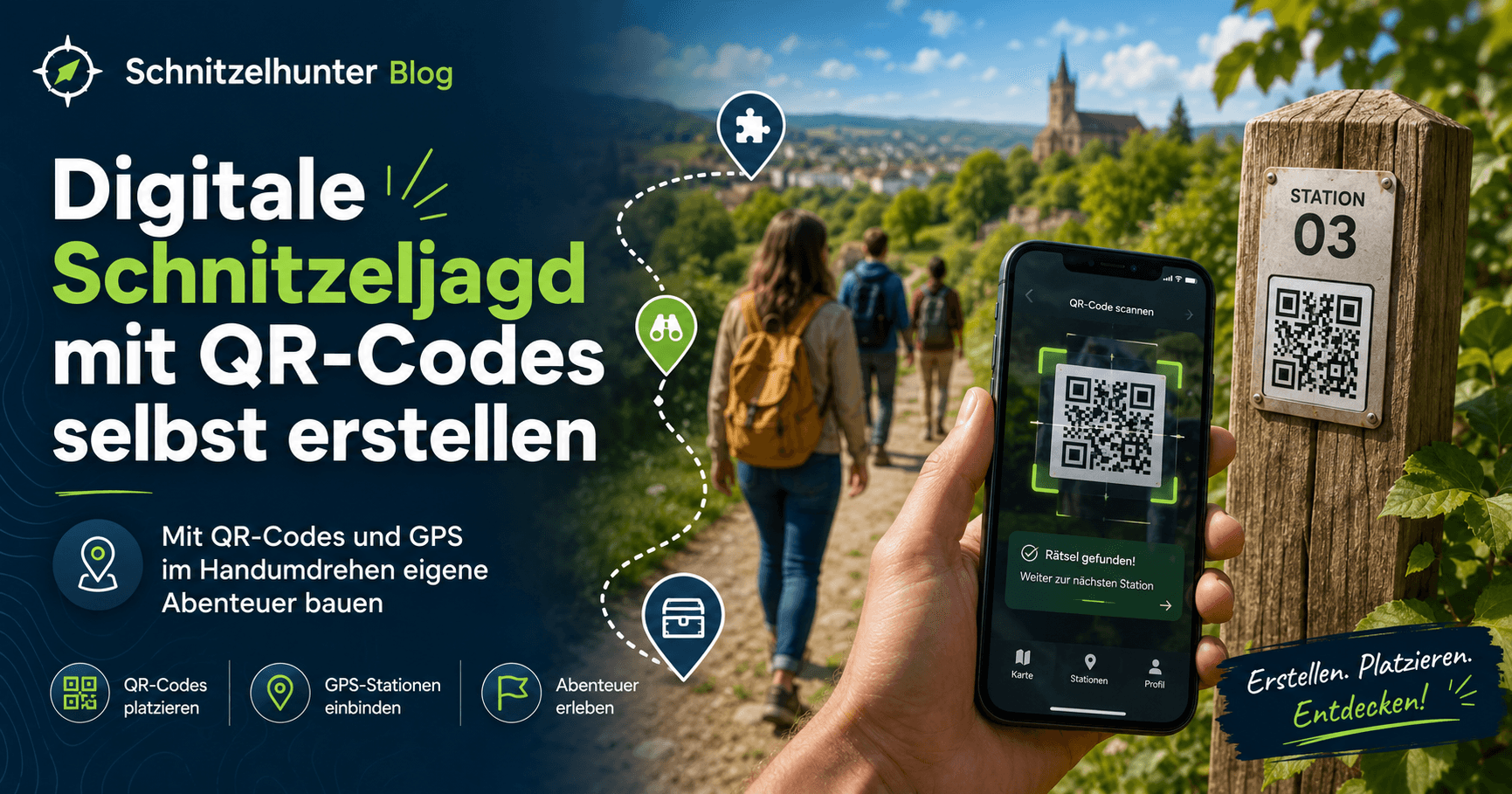
Create your own digital scavenger hunt with QR codes
A scavenger hunt is a classic way to share an adventure, solve puzzles and make memories together. In the past, organisers hid paper clues, prepared directions and marked stations with notes. Today, you can create a digital scavenger hunt with QR codes and GPS in just a few clicks.
With Schnitzelhunter, you can plan your own hunt, add stations, generate QR codes and guide players through a digital adventure step by step. Whether it is for a children's birthday party, a school activity, a club, a team event or a family gathering, a digital hunt makes preparation easier and gives the game a modern feel.
What is a digital scavenger hunt?
A digital scavenger hunt is a modern version of the traditional game. Instead of relying only on paper clues, it uses digital stations, QR codes, puzzles, tasks or GPS locations.
Players move from one station to the next and complete tasks along the way. A station can be opened by scanning a QR code attached to a tree, door, sign, treasure chest or printed map.
Depending on your idea, the hunt can be fully digital, partly digital or a mix of traditional clue cards and digital puzzles.
Why QR codes are ideal for scavenger hunts
QR codes are easy to create and place, and players can scan them quickly with a smartphone. They do not have to install an app, type long links or learn complicated technology.
A QR code can lead straight to a station, where players might see:
- a task
- a puzzle
- a clue
- a story
- a question
- an instruction for what comes next
- a digital surprise
That makes a QR code scavenger hunt suitable for children and adults alike. You can print the codes and attach them at the locations you choose.
Who is a digital scavenger hunt for?
A digital scavenger hunt with QR codes works for many occasions. It is especially popular for children's birthday parties, where puzzles, clues and a treasure hunt can become one little adventure.
Schools, nurseries, clubs, families, companies and event organisers can also use digital hunts. Stations can be adapted to the players' ages, the theme and the location.
Typical uses include:
- children's birthday parties
- family celebrations
- school projects
- holiday programmes
- club events
- team-building events
- town or village rallies
- museum or educational trails
- indoor games in bad weather
- outdoor adventures in a garden, park or forest
Traditional clues, QR codes or GPS?
There are different ways to organise a digital scavenger hunt. QR codes and GPS stations are particularly common.
In a traditional scavenger hunt, players find visible or hidden clue cards and unlock discovered stations with a code. This also lets you use live mode. It works well outdoors, indoors, in gardens, schools or club rooms, and wherever you want to prepare stations in advance.
In a QR code scavenger hunt, players find and scan visible or hidden QR codes. This works especially well indoors, in gardens, schools, club rooms and other places where you can prepare stations yourself.
In a GPS scavenger hunt, stations are tied to locations. Players have to reach specific points to unlock the next station. This is particularly useful for larger outdoor areas, parks and city games.
For some game ideas, a mix of approaches is ideal: QR codes can mark specific stations, while GPS can guide players to places or waypoints.
Create a digital scavenger hunt with Schnitzelhunter
Schnitzelhunter lets you build your own hunt step by step. You do not need programming skills or complicated technical preparation.
The basic process is simple:
- Create a scavenger hunt
- Add a story if you like
- Add stations
- Add puzzles or tasks
- Generate QR codes
- Print and place the codes
- Invite players or teams and let them start
You can quickly turn an idea into a playable adventure.
Step 1: Choose a theme and goal
Before creating your stations, think about the theme of your hunt.
Possible themes include:
- pirate treasure hunt
- detective adventure
- jungle expedition
- magic school
- space mission
- animal trail
- city discovery
- nature adventure
- birthday mission
- secret agent game
A clear theme helps you write suitable puzzles, text and tasks. It also makes the hunt more engaging and consistent for players.
Tip: Schnitzelhunter's AI assistant can help you develop story themes and add to the sense of adventure.
Step 2: Plan the stations
A good hunt has several stations, each with a clear purpose. A station might contain a clue, pose a puzzle or lead players to the next place.
Four to six stations are often enough for a short game. Longer adventures may have eight to twelve or more. Choose a number that suits the players' ages, the available time and the terrain.
For children, keep the route easy to follow. Outdoors, make sure paths are safe and avoid dangerous areas.
Step 3: Add puzzles and tasks
Puzzles are at the heart of a scavenger hunt. They get players thinking, searching and solving problems together instead of simply moving from place to place.
Possible puzzle types include:
- simple questions
- search tasks
- number puzzles
- picture puzzles
- word puzzles
- multiple-choice questions
- short maths problems
- logic puzzles
- clues about nearby objects
- codes or secret writing
With Schnitzelhunter, you can prepare different stations and tasks digitally. This keeps the hunt organised and makes it easier to manage than a pile of paper notes.
Step 4: Create and print QR codes
Once your stations are ready, you can use the matching QR codes. Each code leads to a particular station or task.
Print the codes and place them where you want. For outdoor games, protect them from the weather by laminating them or putting them in clear sleeves.
Make sure the codes stay easy to scan. Avoid creases, very small prints and poorly lit locations.
Step 5: Place stations safely
Placement matters especially when children are taking part. Stations should be easy to reach and away from hazards.
Avoid busy roads, confusing junctions, steep slopes, bodies of water and private property without permission. An adult should supervise when children play.
For younger children, a QR code hunt in a garden, courtyard, park, school building or clearly bounded area is often better than a GPS hunt spread over long distances.
Step 6: Let players begin
When all stations are ready, players can start. They open the starting link or scan the first QR code, then follow the tasks.
They can play individually, in teams or as one group. Small teams often work well for children because they encourage conversation and help keep everyone together.
At the end, you could have a reward waiting: a treasure chest, a solution word, a shared destination, a certificate or a small surprise.
Benefits of a digital scavenger hunt with QR codes
A digital scavenger hunt saves preparation time. You do not need long chains of paper notes, and you can organise content more easily.
The main benefits are:
- quick setup
- easy use
- a modern playing experience
- ready-to-use QR codes
- suitable for indoor and outdoor play
- flexible content
- ideal for children, families, schools and events
- less paper clutter
- digital tasks and clues
- the option to combine approaches with GPS
Digital stations are also easier to structure, especially when you prepare several puzzles, clues or game variations.
Tips for a successful QR code scavenger hunt
Test your hunt yourself before it starts. Check that every QR code works, the text is clear and the route makes sense.
It also helps to:
- print QR codes large enough
- protect outdoor stations from the weather
- keep spare printouts
- check smartphone batteries
- consider mobile data or Wi-Fi coverage
- adapt tasks to the age group
- plan a realistic duration
- add small hints for difficult puzzles
- define the start and finish clearly
For children, keep tasks short, clear and playful. Puzzles for adults or team events can be more challenging.
Indoor or outdoor: which is better?
A QR code hunt works both indoors and outdoors.
Indoor hunts are well suited to homes, schools, club rooms, museums and venues. Codes can be attached to doors, furniture, walls, objects or station tables.
Outdoor hunts offer more movement and adventure. Gardens, parks, walking trails, courtyards and public spaces are all possibilities. Pay particular attention to safety, weather and whether the codes are easy to see.
A combination often works well for children's birthday parties: a few stations in the garden, some tasks indoors and a treasure chest at the end.
Common mistakes in digital scavenger hunts
Even a digital hunt needs preparation. Common problems include too many stations, overly difficult puzzles and unclear clues.
In particular, avoid:
- QR codes that are too small
- badly placed stations
- text that is too long
- unclear tasks
- unsafe routes
- distances that are too great
- skipping the test run
- puzzles that do not suit the age group
- too little spare time
A good hunt does not have to be complicated. It should be clear, exciting and easy to play.
Digital scavenger hunts for children
A digital hunt is especially exciting for children when it tells a story. Instead of simply completing one task after another, they become part of an adventure.
For example, young explorers might have to find lost clues to open a treasure chest. Every QR code brings them one step closer. Each station holds a puzzle, a small task or another part of the story.
Children should not have to stare at a screen for too long. Digital tools should support the adventure, while movement, searching, teamwork and discovery remain central.
Digital scavenger hunts for schools and groups
Digital hunts are useful for schools, youth groups and clubs too. They combine learning with play and movement.
Possible topics include:
- nature and the environment
- history
- mathematics
- languages
- reading comprehension
- navigation
- teamwork
- local history and geography
Teachers and group leaders can prepare stations and adapt tasks to the learners' level. The result is a more active learning format than a traditional worksheet.
A digital scavenger hunt without installing an app
One advantage of Schnitzelhunter is how easily players can join. A digital hunt should have as few barriers as possible. In a group, it matters that nobody has to install an app or create an account first.
QR codes and links make starting simple: players scan a code, open the station and begin.
Conclusion: QR codes make scavenger hunts easier and more modern
A digital scavenger hunt with QR codes combines a classic adventure with modern technology. You can prepare stations, add puzzles, show clues digitally and guide players through an adventure of your own.
Schnitzelhunter makes it easy to create a hunt and adapt it to your occasion. Whether you are planning a birthday party, school project, family gathering or team event, QR codes make organising easier and playing more exciting.
If you want to create a scavenger hunt, Schnitzelhunter is a simple place to start. Plan your stations, generate the QR codes, place them where you want and let players discover your adventure.